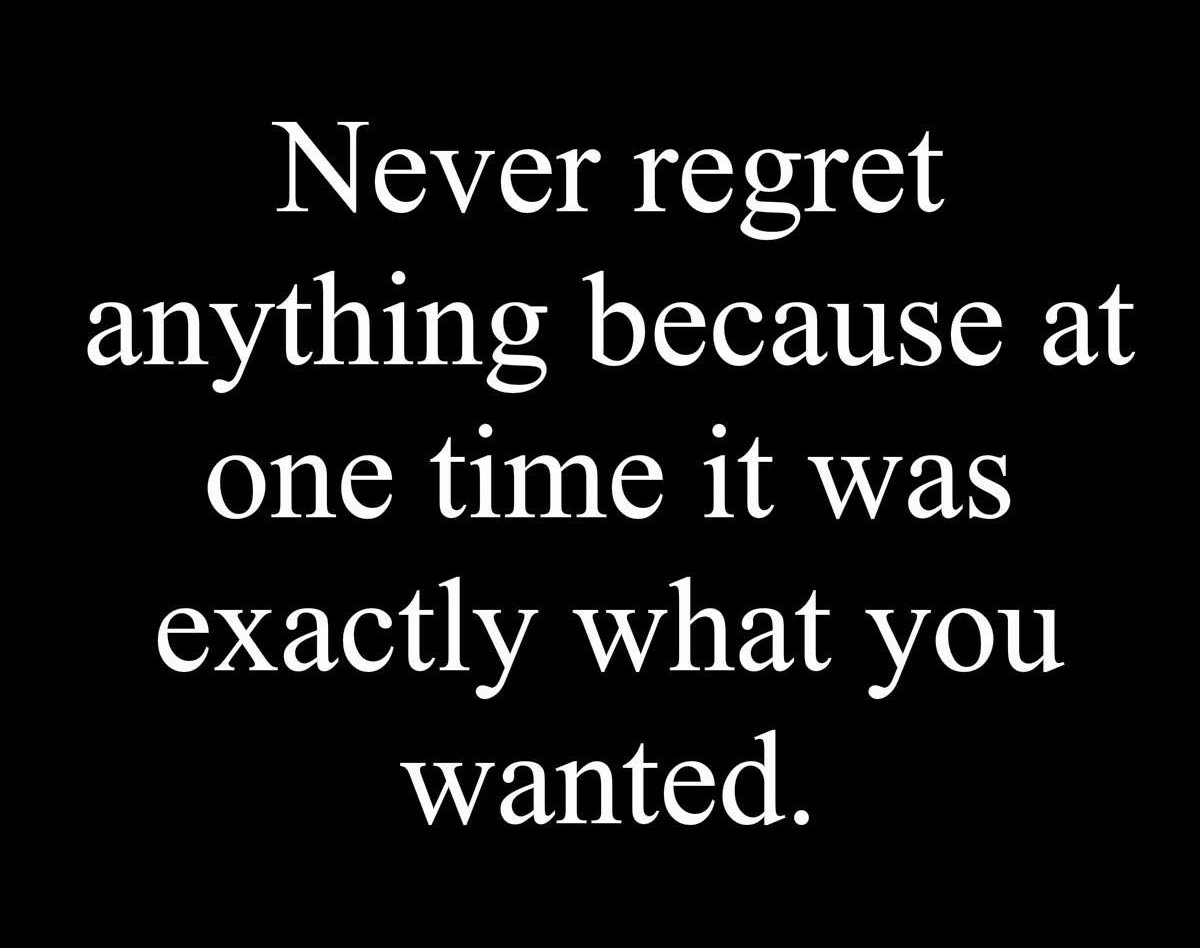
Regret is never sudden. It gradually takes over each time we judge our past selves with the wisdom of our present self. It’s like looking at a younger version of you and saying, “You should have done better,” “Maybe I shouldn’t have said that,” “Why didn’t I choose differently?” wishing you could go back and rewrite what has already been lived. At the start, it feels harmless, just a momentary reflection. But slowly, regret grows roots. It starts replaying the past like a broken record and pulls us back to the same questions again and again. And before we realize it, regret becomes a pattern; creeping into our mornings, lingering through our workday, and settling into our nights thus creating a very low-vibe energy which devastates our presence and thus our future. Regret if seen more transparently is an emotional reflection of an unfulfilled expectation; an expectation we had from life, from others, or most commonly, from ourselves. It is a feeling born when our reality didn’t match our internal story.
Just for your understanding, this chapter is written by someone who doesn’t fall into regret very often. Whenever I feel upset about a present situation and catch myself thinking, “I wish I had chosen differently,” a gentle reminder always returns; the past cannot be changed; so what can I do today to feel better first? I know it may sound simple to read, and even simpler to suggest, but this ability to return to the present has been cultivated over years. It has become a way of living for me. And yet, I deeply understand how regret feels when it creeps in. In my coaching sessions, I have observed that nearly 87% of my clients are held back by some form of regret, and because of that, they struggle to feel happy in their present life.
One day, while I was arranging laundry, my daughter walked up to me and asked, “Mai, do you regret anything from your past?” She continued, “For example, you are so deeply involved in training, coaching, and psychological work now, but you graduated in design and studied architecture. Do you ever wish you had studied psychology instead? Maybe you would have done even better than what you have achieved now.” Her question took me by surprise, and for a moment I wondered where is this coming from? But instead of questioning her, I chose to simply share the thoughts that arose within me the moment she asked. I said, “Now that you are asking and now that I am actually thinking about my past which I rarely do I feel I am happy that I studied design. It shaped me, helped me build programs and curriculums, empowered me to deliver them effectively, and gave me the foundation to coach and mentor the people I work with today.” She raised her eyebrows and said, “Oh, that’s interesting!”
Regrets can be over various situations:
Parents felt regret because they insisted their daughter marry a man despite her hesitation, and the marriage eventually ended in divorce.
A teacher regretted pushing a bright but sensitive student, to perform better, only to learn he broke down under pressure and tried to attempt suicide.
A husband regretting canceling the Maldives trip with his wife on their anniversary because he prioritized a work meeting he thought was “too important to miss.”
A mother regretting scolding her 10-year-old son harshly for losing a school competition, only to find him crying silently in the bathroom.
A colleague regretted not standing up for his teammate, when he was unfairly blamed during a project review.
A son regretting travelling with friends on a weekend even though his mother was in the hospital, assuming she would recover quickly.
Let’s pause for a moment to truly understand these regrets that are the constant pricking feelings that leave us drained, weak, or even helpless. The only real antidote to regret is gratitude; not the forced kind, not the surface-level positivity, but genuine appreciation for the lessons your past has offered. Some of you may wonder, “What gift could possibly lie in that experience?” And that is where perspective comes in. If you can stay with me and view your regrets through this lens, even briefly, you may discover a shift; one that leads you toward clarity and empowerment. After all, the highest summit of any human life is progression and self-empowerment. When you begin saying “Thank you” to your past, your soul feels safe again and that is where your empowerment quietly begins to rebuild itself. When you shift from “Why did this happen to me?” to “What am I meant to learn from this experience?” something powerful happens; acceptance slowly replaces the drama we humans so naturally create. And as acceptance flows in, your inner world becomes calmer, steadier, and clearer. The fog of feeling stuck begins to dissolve, and the path forward (your path) starts becoming visible again.
Also I am sure you would agree with me when I say that we all process our emotions differently. We all heal at our own pace. But there comes a moment in every life when we must decide: Do I want to stay stuck in the story of what went wrong, or do I want to move forward with awareness? Forgive your past. Forgive yourself first for what you didn’t know back then. Forgive others for the roles they played. And walk forward; not with regret, but with gratitude for the lessons that shaped you. One of the most important things we must acknowledge is that regret acts like a thief of our future. It pulls our attention away from what matters, unsettles our emotions, and slowly begins to shape our identity. Without even realizing it, we start designing our future based on the wounds of our past rather than the unlimited possibilities of our present. When the mind is stuck in yesterday, the body is left to drag itself through today. That is how regret quietly reshapes our future, one distracted moment at a time. And when today is disturbed, tomorrow naturally becomes ambiguous.
Last year, I had a once-in-a-lifetime opportunity. I visited a serene monastery on the outskirts of New York, a place founded by Thich Nhat Hanh, one of the pioneers of modern mindfulness and originally from Vietnam. The monastery offered several programs; one-day immersions, week-long retreats, three-month stays, and more. Since I was there only for a short visit, I chose the one-day program, which required just a modest donation of $20. During the session, the monk leading the program shared a story to explain how regrets can weigh us down, drain our energy, and pull us away from mindful living. Here’s the story he told: There was once a young traveler who went to his master seeking a solution for all the mistakes he had made in the past. The master gently advised him to walk through a healing forest where monks helped visitors find clarity. Filled with hope, the traveler began his long journey through the forest trail. At the start, he carried a small backpack; light, almost empty, and effortless to manage. At the first stop, he met a monk who handed him a small stone. “This is a reminder of what you could have done better,” the monk said. Peter didn’t think much of it assuming it’s a part of the process as suggested by his master. He placed the stone in his backpack and continued. At the next stop, one more monk gave him another stone. “This is for the opportunity you missed,” the monk said. The journey continued, and every time he encountered monks or even a memory he was handed more stones: A stone for a mistake. A stone for a lost relationship. A stone for something he said in anger. A stone for something he should have said but didn’t. Peter kept collecting them, believing it was his responsibility to carry them. Soon the bag became heavy. His steps slowed down. His shoulders started hurting. The path ahead looked longer than before. By afternoon, exhausted and breathless, Peter sat under a tree. He tried to stand up again but couldn’t. The weight was too much. Out of nowhere an old monk approached him and asked gently, “Why are you carrying these stones?” Peter replied, “I thought I had to. These stones remind me of my past and what went wrong. Isn’t this how I make sure I don’t repeat mistakes?” The monk smiled, opened Peter’s backpack, and began emptying it one stone at a time. “The past is not meant to be carried. It is meant to be learned from. Lessons are light; regret is heavy.” “But what do I do with all these mistakes then?” Peter asked. The sage pointed to the empty backpack. “Fill it with gratitude. It is the only weight that makes the journey easier.” Peter hesitated, but the monk said, “Say this with me, my dear young traveler – Thank you for the lessons from my past.” And the moment Peter said it, something felt lighter and a bit brighter within him. And for the first time in a long while, he noticed the beauty of his present life. The trees appeared greener, the air felt fresher, and his footsteps grew lighter. He walked out of the healing forest with a gentle smile that needed no particular reason. Nothing can erase the past, but gratitude helps transform how we carry it. Like Peter, we all carry our own backpack of stones, small or big regrets collected over years. But life does not ask us to walk backward, can you really? Or fix what already happened. Life asks us to walk forward, wiser and lighter.
As you close this chapter, I invite you to practice a simple yet powerful daily ritual, one that gently dissolves regret and strengthens your gratitude attitude. 1. Close your eyes and take one slow, conscious breath. 2. Recall a moment of regret not to relive it, but simply to acknowledge its presence. 3. Say silently or aloud – “Thank you for teaching me what I needed to learn. I release you now.” 4. Take a deep exhale and imagine the regret leaving your body with your breath. 5. End with these gratitude statements: “I am grateful for this moment of clarity.” “I am grateful for a new day to live better.” “I am grateful that I am growing.” Practice this ritual for 21 days. You will notice the emotional charge softening. The heaviness is beginning to lift. And your inner world becomes lighter, clearer, and more aligned. Because freedom from regrets is not accidental. It will only happen when you honor your feelings, process them with honesty, deal with it, heal with it and choose gratitude as your way forward. This is how you walk into a future designed by consciousness, not by the shadows of your regrets.